Set a target tempo without making drum practice all about BPM
TeachersA 90 BPM target means little on its own. Which groove should the student play? For how many bars? What matters about the ghost notes or the timing? A tempo becomes useful once it is tied to clear music and practice conditions.
Students choose their permissions for each teacher. You see results for work you assigned when sharing was turned on at launch and the student still allows you to view results. They can also share other personal practice sessions individually and withdraw that sharing.
Start with the score
Choose the groove and the difficulty you will come back to in the lesson. Keep one pattern to explore different tempos, or build a program of complementary grooves. If you want to understand a change between sessions, do not change the music and the tempo at the same time.
No starting tempo suits every student. What you observe in lessons remains the basis for an individual goal.
Keep three tempos apart
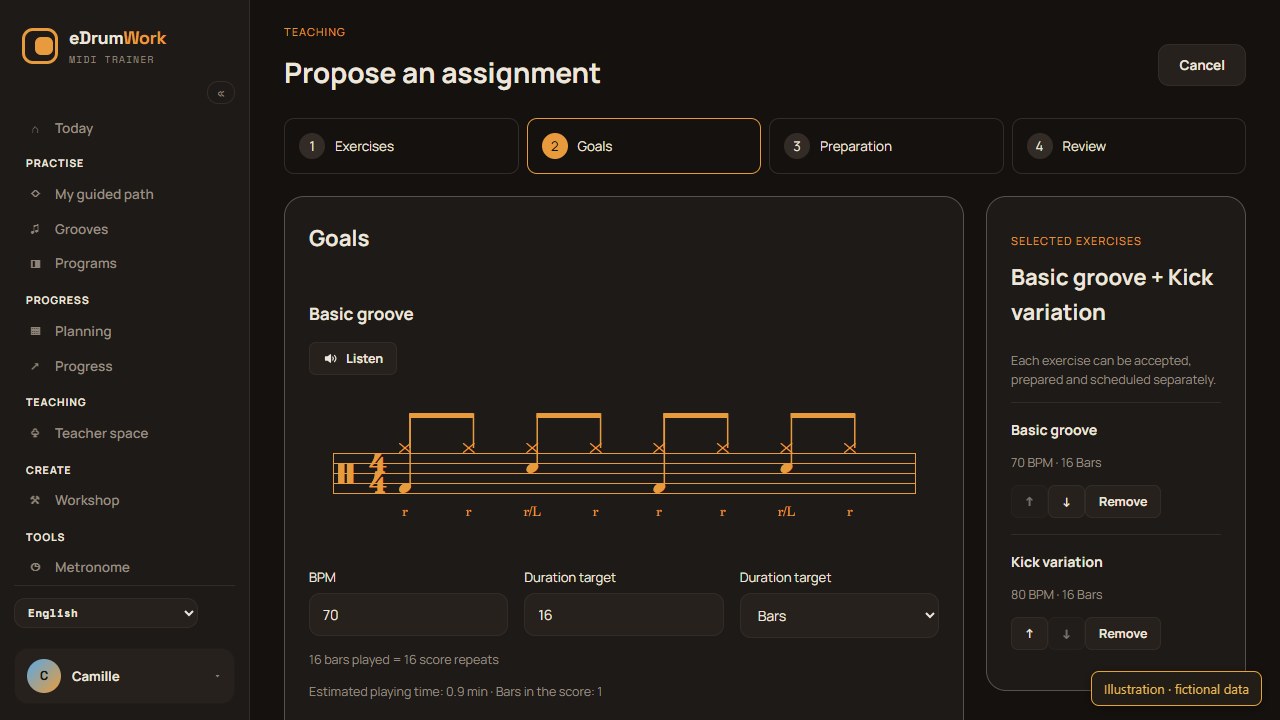
The target tempo is what you prescribe. The starting tempo shows where the student begins. The tempos actually played describe the conditions behind the saved results.
Preparation can use a different tempo from this target. Step by step has no metronome.
A fictional example: you assign a groove at 90 BPM for 16 bars and the student starts at 75 BPM. Practicing slower can be a useful step. It neither proves success at 90 BPM nor automatically counts as a failure.
Add a duration and keep its unit
Use bars or minutes depending on the task. Bars set a musical quantity; minutes set a time frame. Do not treat them as interchangeable through a rough conversion.
The assigned duration is a goal. Elapsed session time may include pauses and does not prove uninterrupted active practice.
Compare quality at comparable tempos
Look at the mean timing error, how much it varies, and missing or extra hits when they are available. Dynamics can add context on ghost notes if the kit is properly calibrated.
Compare the same version of the score, comparable tempos and known assessment rules. A different grade after a change in conditions does not necessarily mean improvement or decline.
Decide the next assignment together
You can keep the tempo, shorten the material, isolate a difficulty or set a new target. No rule says you must add a fixed number of BPM after every result.
The teacher area does not choose the student’s next tempo for you. Assigned work keeps its score and goals; a new assignment makes the next step explicit. Other personal sessions stay private unless the student chooses to share them, and eDrumWork has no teacher–student messaging.
Learn how to combine goals into a practice program.