How can you review a drum student’s practice between lessons?
Teachers“Practice this groove for next week” leaves questions open. At what tempo? For how many bars? What should the student focus on? Their account of the week is still useful, but a precise assignment and recorded results give you both a common starting point for the next lesson.
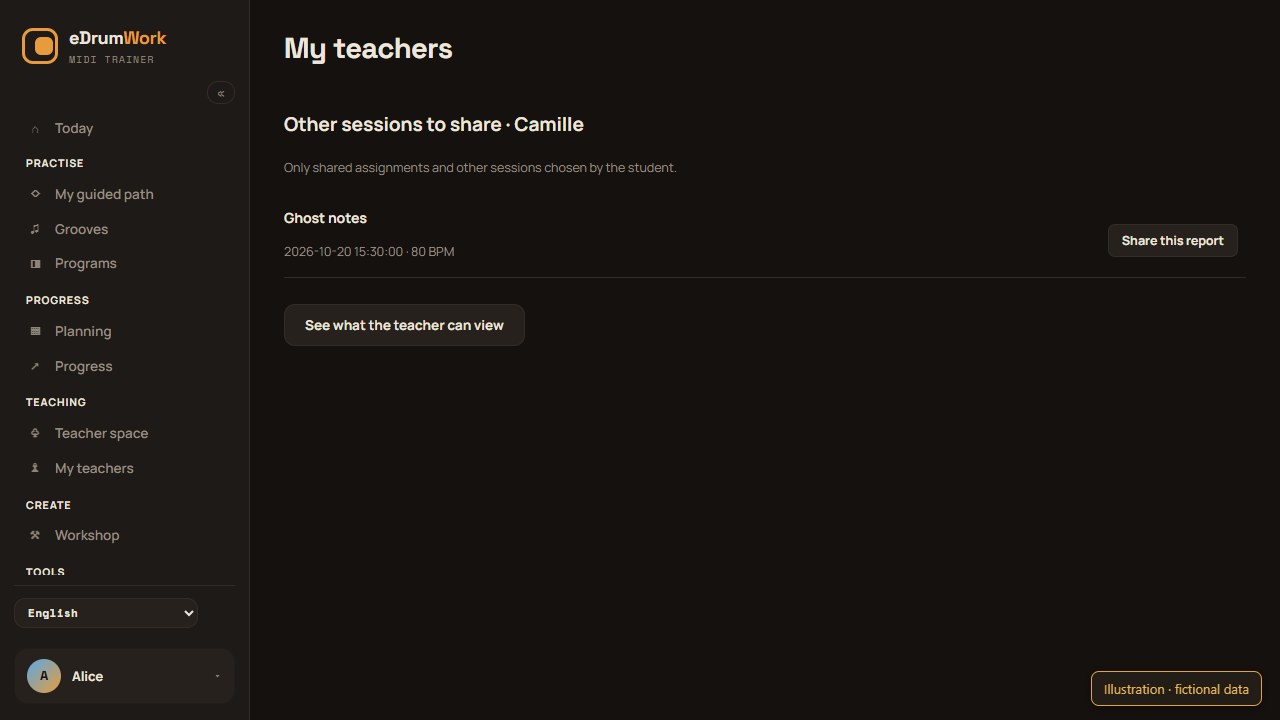
Students choose their permissions for each teacher. You see results for work you assigned when sharing was turned on at launch and the student still allows you to view results. They can also share other personal practice sessions individually and withdraw that sharing.
Make the assignment specific
Choose a score, target tempo and duration. Several exercises can remain independent or form an ordered program. An optional target date marks when to check in; it does not book a lesson.
Pick a well-defined difficulty you can work on together, not a broad instruction like “improve your rhythm”.
Keep assigned and independent practice separate
The student accepts the link, then chooses which independent exercises to accept; a program remains a sequence. To share an assigned result, they launch the received work on an electronic kit connected over MIDI with a compatible setup.
Playing the same groove from their own library does not share results automatically. The student can choose individual sessions to share with you; the rest of their independent practice stays private.
Review the context first
Start with the steps that have results and the tempos played. Then look at the available measurements: timing, how much the timing errors vary, and missing or extra hits. Dynamics need usable data and a properly calibrated kit.
Preparation results and planned dates have separate sharing permissions. Preparing a passage remains distinct from playing the whole exercise.
A step with no recorded session only means no assigned result is available. The student may have practiced on an acoustic kit, in a lesson or outside the assignment. Elapsed session time can include pauses and does not prove continuous active practice.
Example: three steps for the next lesson
This fictional program illustrates a possible structure:
- A familiar groove at 70 BPM for 16 bars.
- A kick variation at 80 BPM for 16 bars.
- A groove with ghost notes at 70 BPM for 8 bars.
You find results for the first step, a session started at a slower tempo for the second and nothing for the third. That gives you specific questions for the lesson, not grounds to judge the student’s motivation.
Use the results to start a conversation
Only compare sessions whose score, tempos and assessment rules you know. MIDI cannot show posture, acoustic sound or every aspect of musicianship. Discuss the results in the lesson or through your usual channel: eDrumWork has no teacher–student messaging. A student can end the link, and you then lose access to their results in the teacher area.
Next, learn how to build a drum practice program.